The global skyline is undergoing a radical transformation as the world pivots toward a more sustainable and ecologically responsible future. For decades, skyscrapers were seen as symbols of industrial might and energy consumption, often criticized for their massive carbon footprints and reliance on external power grids.
However, a new era of architectural engineering has arrived, bringing with it the concept of the “Net-Zero” high-rise. These structures are not just buildings; they are self-sustaining ecosystems designed to produce as much energy as they consume over the course of a year. This ambitious goal is achieved through a sophisticated blend of renewable energy integration, advanced material science, and intelligent climate management systems. In 2025 and 2026, we are seeing cities from Dubai to New York embrace these vertical marvels to meet aggressive climate targets.
The engineering behind these structures involves capturing wind at high altitudes, turning glass facades into solar harvesters, and recycling every drop of water used within the building. As urban populations continue to swell, these self-sustaining towers represent the only viable path forward for dense, modern civilizations. This article will explore the intricate engineering secrets, the revolutionary materials, and the environmental impact of these towering achievements in green technology.
A. The Core Philosophy of Net-Zero Architecture
The fundamental principle of a net-zero building is balance. To reach a net-zero rating, an engineer must first reduce the building’s energy demand to the absolute minimum.
Only after the energy demand is slashed can renewable sources like solar or wind be expected to cover the remaining needs. This requires a holistic approach where every floor, window, and pipe is optimized for efficiency.
A. Passive Design involves using the building’s orientation to maximize natural heat and light.
B. Active Systems include mechanical technology like heat pumps and solar arrays that generate or move energy.
C. The “Performance Gap” is the difference between how a building is designed to perform and how it actually performs in the real world.
D. Operational Carbon refers to the emissions generated during the day-to-day use of the building.
E. Embodied Carbon is the total energy used to create the materials and construct the skyscraper itself.
B. Vertical Wind Harvesting: Tapping High-Altitude Energy
One of the greatest advantages of a skyscraper is its height, which grants access to stronger and more consistent wind speeds than ground-level structures. Engineers are now integrating turbines directly into the architectural form of the tower.
By carving “wind holes” or aerodynamic channels through the middle of a building, engineers can accelerate airflow toward internal turbines. This generates significant electricity without the need for massive, unsightly external windmills.
A. Vertical Axis Wind Turbines (VAWTs) are often preferred for skyscrapers because they can capture wind from any direction.
B. Aero-elastic Flutter is a new technology that uses vibrating “reeds” to generate energy from light breezes.
C. Computational Fluid Dynamics (CFD) is used to model how wind will move around a building’s specific shape.
D. The “Venturi Effect” is exploited to create high-pressure zones that spin turbines faster than open-air winds.
E. Noise and Vibration Dampening is a critical engineering challenge to ensure residents aren’t disturbed by the spinning blades.
C. Solar Glass: Turning Windows into Power Plants
Traditional solar panels are often too heavy or visually unappealing to cover an entire skyscraper. The breakthrough in net-zero engineering is the development of transparent photovoltaic (PV) glass.
This allows every square inch of a building’s facade to act as a solar collector. While less efficient than solid panels, the sheer surface area of a 100-story tower provides an enormous amount of energy.
A. Cadmium Telluride (CdTe) thin-film cells can be applied as a coating to standard architectural glass.
B. Perovskite Solar Cells are a rising technology that offers higher efficiency and lower manufacturing costs.
C. Concentrated Solar Glazing uses small lenses to direct light toward hidden solar strips in the window frames.
D. Spectrally Selective Coatings allow visible light to enter the building while capturing infrared and UV light for energy.
E. Dynamic Tinting integrated with PV glass automatically darkens the windows in summer to reduce cooling loads.
D. Geothermal Foundations: Using the Earth as a Battery
Skyscrapers require incredibly deep foundations to stay stable, sometimes reaching hundreds of feet into the ground. Engineers are now using these structural piles as “thermal exchangers.”
By running fluid-filled pipes through the concrete foundation piles, the building can tap into the constant temperature of the Earth. This provides a natural heat source in the winter and a cooling sink in the summer.
A. Ground Source Heat Pumps (GSHP) are used to move thermal energy between the ground and the building.
B. Thermal Piles serve the dual purpose of supporting the weight of the tower and providing energy.
C. Seasonal Thermal Energy Storage (STES) allows the building to “save” heat from the summer to use in the winter.
D. Deep-Well Injection can reach even hotter layers of the Earth for high-density energy needs.
E. Closed-Loop Systems ensure that the fluid used for heat exchange never comes into contact with the local groundwater.
E. Advanced Insulation and the “Airtight” Envelope
A skyscraper can generate all the energy in the world, but it won’t be net-zero if that energy leaks out through the walls. The “Building Envelope” must be perfectly sealed to maintain internal temperatures.
Engineers use “Thermal Break” technology to ensure that metal frames don’t conduct heat from the outside to the inside. Vacuum-insulated panels are also being used to provide maximum insulation with minimum thickness.
A. Triple-Pane Glazing with argon gas filling creates a powerful barrier against thermal transfer.
B. Blower Door Testing is conducted during construction to find and seal even the smallest air leaks.
C. Smart Membranes act like “human skin,” allowing moisture to escape while preventing drafts from entering.
D. Aerogel Insulation, once used by NASA, is now becoming a viable material for ultra-efficient skyscraper walls.
E. Green Roofs and Living Walls provide an extra layer of insulation while reducing the “Urban Heat Island” effect.
F. Circular Water Management and Hydro-Efficiency
Water is heavy and energy-intensive to pump to the top of a skyscraper. Net-zero buildings focus on “On-Site Treatment” to reduce the need for municipal water supplies.
Greywater from sinks and showers is filtered and reused for flushing toilets or cooling mechanical systems. This creates a circular loop that can reduce water consumption by over 70%.
A. Rainwater Harvesting Systems capture water from the roof and facades for irrigation and non-potable use.
B. Blackwater Treatment Plants located in the basement can turn sewage into clean, usable water through biological filtering.
C. Low-Flow Fixtures are standard, but they are now paired with AI-monitored sensors to detect leaks instantly.
D. Condensate Recovery captures the water that drips from air conditioning units, which is surprisingly high in humid climates.
E. Vacuum Sewage Systems use air pressure instead of water to move waste, drastically reducing total water usage.
G. The Role of AI in Real-Time Energy Optimization

A self-sustaining skyscraper is too complex for a human to manage manually. Artificial Intelligence (AI) acts as the building’s “nervous system,” making thousands of micro-adjustments every second.
The AI analyzes data from thousands of sensors tracking occupancy, sunlight, and weather patterns. It can move heat from the sunny side of the building to the shady side to balance the load.
A. Predictive Modeling allows the building to “cool down” in advance of a predicted heatwave.
B. Occupancy Sensing ensures that lights and AC are only active in zones where people are actually present.
C. Digital Twins are virtual replicas of the building that the AI uses to run simulations before making changes.
D. Edge Computing allows sensors to process data locally, ensuring the building responds instantly to changes.
E. Grid-Interactive Systems allow the building to sell excess energy back to the city during peak demand.
H. Biomimicry: Engineering Inspired by Nature
Nature has already solved the problem of creating self-sustaining vertical structures—we call them trees. Engineers are increasingly looking to biological forms to improve the efficiency of skyscrapers.
For example, the structure of a termite mound has inspired natural ventilation systems in high-rises. These systems allow hot air to rise and escape through “chimneys” while drawing cool air in from the base.
A. Hexagonal Lattices inspired by honeycombs provide maximum structural strength with the least amount of material.
B. Self-Shading Facades mimic the way cactus needles or leaves protect the main body of a plant from the sun.
C. Mycelium-Based Materials are being tested for acoustic insulation, as they are completely biodegradable and renewable.
D. Phototropic Buildings are being designed to slightly “tilt” or move to follow the sun’s path for maximum solar capture.
E. Fibonacci-Sequence layouts are used to optimize the placement of windows for the most efficient natural lighting.
I. The Challenges of Retrofitting Existing Towers
While building a new net-zero skyscraper is easier, the real challenge lies in the thousands of existing “energy-guzzlers.” Retrofitting older towers is essential for meeting global climate goals.
This often involves “Re-Skinning” the building—placing a new, high-efficiency facade over the old one. It is a massive engineering undertaking that must often be done while the building is still occupied.
A. Deep Energy Retrofits can reduce an old building’s energy use by over 50% without changing its structure.
B. HVAC Modernization involves replacing old boilers with high-efficiency electric heat pumps.
C. Window Film Application is a cost-effective way to improve the thermal performance of older glass.
D. Smart Metering can be installed in old units to give tenants better control over their energy consumption.
E. Adaptive Reuse projects turn old office towers into sustainable residential spaces with modern green technology.
J. The Economic Case for Self-Sustaining Buildings
There is a common misconception that net-zero skyscrapers are too expensive to be practical. While the initial construction costs are higher, the long-term ROI is undeniable.
With zero energy bills and lower maintenance costs, these buildings pay for themselves within a decade or two. Furthermore, they attract premium tenants who are willing to pay more for “Green-Certified” spaces.
A. Tax Incentives and government grants are increasingly available for developers who hit net-zero targets.
B. Energy Independence protects the building owner from future spikes in electricity or gas prices.
C. Lower Insurance Premiums are often granted to buildings with advanced fire and flood-sensing automation.
D. Employee Productivity is proven to be higher in buildings with better air quality and natural light.
E. Carbon Credits can be earned and sold by buildings that produce more energy than they use.
K. Social and Psychological Impacts of Vertical Forests
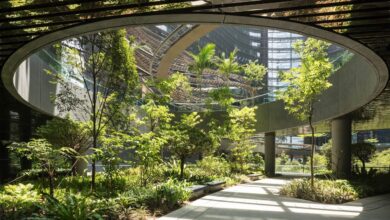
A net-zero skyscraper isn’t just a machine; it’s a home or a workplace. The inclusion of “Sky Gardens” and vertical forests improves the mental health of the people inside.
Living and working in a space that feels connected to nature reduces stress and fosters a sense of community. These buildings are becoming the new “lungs” of our concrete jungles.
A. Biophilic Design elements, such as indoor waterfalls and parks, help regulate humidity and air quality.
B. Sky Bridges allow people to move between buildings without going down to the street, creating a “secondary” city level.
C. Urban Farming on the balconies of these towers allows residents to grow their own organic food.
D. Communal Energy Zones encourage residents to work together to hit monthly sustainability targets.
E. Noise Reduction from the thick insulation and greenery creates a peaceful environment in the middle of a noisy city.
L. The Future: Carbon-Negative Skyscrapers
The ultimate goal for 2030 and beyond is to move from “Net-Zero” to “Carbon-Negative.” This means the building actually removes more carbon from the atmosphere than it produces.
This will be achieved through carbon-capture technology integrated into the building’s exhaust systems and materials that “eat” CO2. The skyscraper of the future won’t just be “less bad”—it will be a positive force for the planet.
A. Carbon-Cured Concrete uses CO2 as an ingredient, locking it away forever in the building’s structure.
B. Algae-Filled Facades can grow biomass for fuel while scrubbing CO2 from the local urban air.
C. Industrial-Scale Air Scrubbers could be placed on the roofs of skyscrapers to clean the city’s air.
D. Direct Air Capture (DAC) modules are being designed to fit onto existing skyscraper mechanical floors.
E. “Living Bricks” containing bacteria can repair cracks in the building while producing oxygen.
Conclusion
The net-zero skyscraper is the final evolution of our urban architectural journey.
It combines the highest forms of engineering with a deep respect for natural systems.
By generating their own power, these towers ensure a resilient future for our growing cities.
The integration of AI allows for a level of efficiency that was previously unthinkable.
Every window and foundation pile is now a vital part of the energy-generating ecosystem.
Water recycling and vertical farming turn these structures into true life-support systems.
The economic benefits of sustainability are finally outweighing the costs of traditional building.
Retrofitting our current skylines is the next great challenge for the modern engineer.
We are moving toward a world where buildings act like trees, cleaning our air and water.
The psychological impact of these green spaces will create a happier and healthier urban population.
The skyline of the future will be a testament to humanity’s ability to live in harmony with the Earth.